DC/DC Converters from Querom – High-Efficiency DC/DC Converters
for Industrial Systems
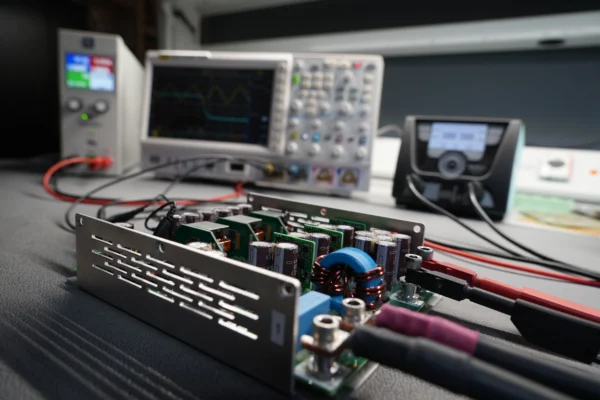
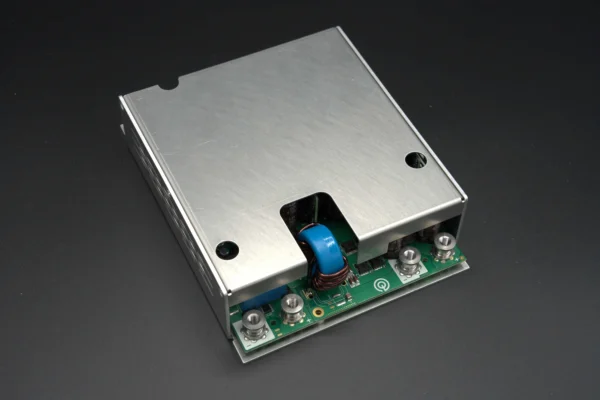
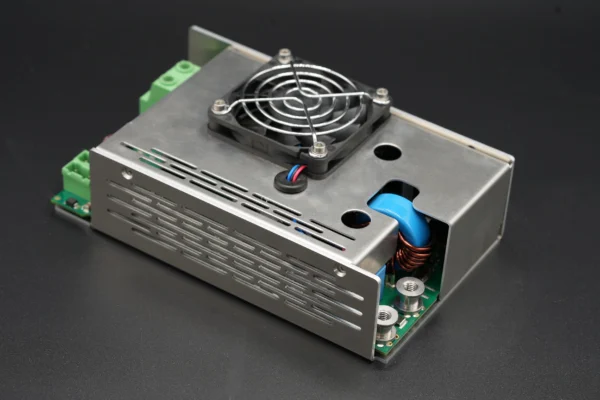
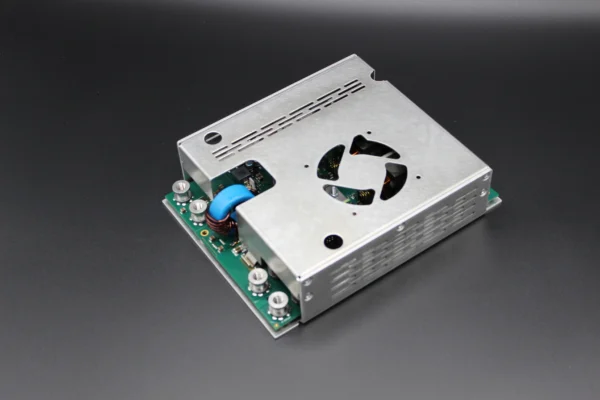
Querom develops and manufactures high-efficiency DC/DC converters for industrial systems – in the 48V, 96V and high-voltage classes, bidirectional, modular and customized. As DC voltage converters, our devices convert a regulated DC input voltage into a precisely regulated DC output voltage – whether for mobile robotics, energy storage systems, fuel cells or other industrial systems. Development and manufacturing take place entirely in Germany: 100% Made in Germany, modular in design and tailored to the requirements of your system.
On this page, you will learn what defines a DC/DC converter, which topologies, voltage classes and features Querom offers, and how to select the right DC/DC converter for your project.
For this purpose, we have designed two modular DC power platforms in recent years. The low-voltage DC/DC converter platform covers an input voltage range of up to 60VDC and therefore primarily addresses the safety extra-low voltage range (SELV). In addition, based on the LV DC/DC converter platform, we have also developed a 96V DC/DC converter that can operate with an input voltage range of up to 120V. The high-voltage platform covers an input voltage range of up to 1,000VDC and is suitable for high-voltage applications.
What is a DC/DC converter? – Excursus
A DC/DC converter—also known as a DC voltage converter—converts an input DC voltage into a regulated output DC voltage.
Unlike an inverter or transformer, DC voltage converters operate exclusively with direct current (DC) on both the input and output sides. The converter steps up, steps down, or inverts the voltage. A key advantage over AC systems is that DC converters can be integrated directly into DC microgrids, battery systems, and solar energy architectures without the need for an intermediate step involving AC voltage.
Industrial DC/DC converters are used wherever different voltage levels within a system need to be connected—from 24V control power supplies to high-voltage DC link circuits.
How does a DC/DC converter work?
A DC/DC converter works by chopping the input voltage via fast-switching power semiconductors (MOSFET or IGBT) and filtering it into a regulated output voltage by means of inductors and capacitors. The switching process – known as pulse-width modulation (PWM) – takes place at high frequency, typically in the range of several tens to several hundreds of kilohertz. Control electronics continuously monitor the output voltage and adjust the duty cycle of the switching signal in order to keep the desired output voltage stable. The underlying topology determines whether the converter steps the voltage down, steps it up or can transfer energy bidirectionally – more on this in the section on topologies.
Which components does a DC/DC converter contain?
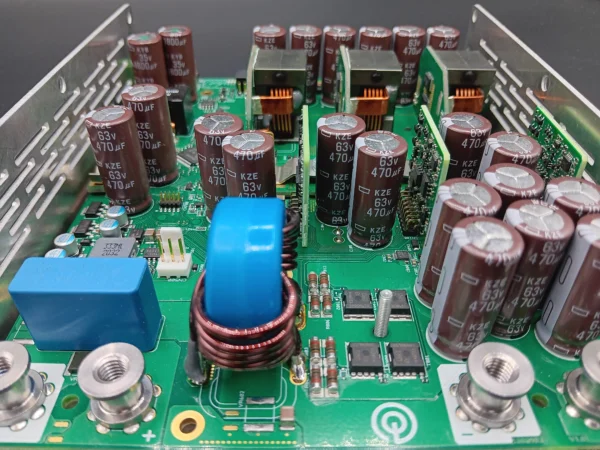
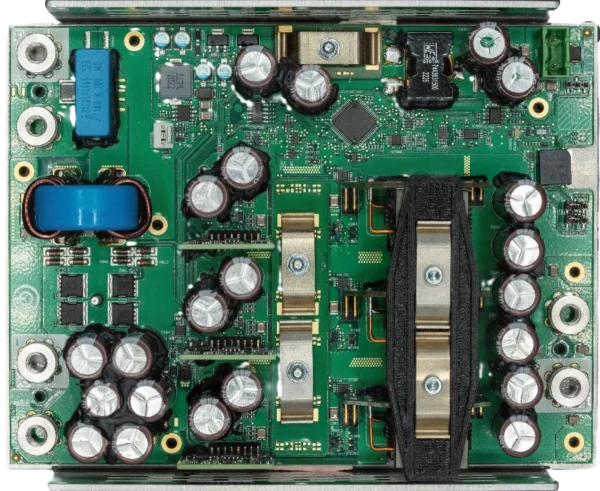
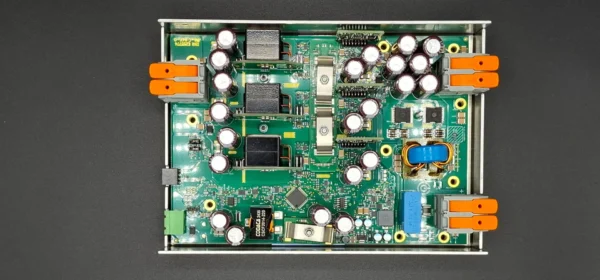
An industrial DC/DC converter essentially consists of four component groups:
- Power semiconductors (Si or SiC MOSFETs) – switch the current at high frequency; SiC variants offer lower switching losses and enable higher switching frequencies.
- Magnetic components (inductor / storage choke) – store and transfer energy; their design has a major influence on efficiency and output ripple.
- Capacitors – smooth the input and output voltages and serve as an energy buffer during transient load peaks.
- Control electronics (microcontroller / DSP) – regulate the output voltage via PWM, monitor temperature and current, and communicate with higher-level systems via CAN, Modbus or an analog interface.
Which voltage classes for DC/DC converters does Querom offer?
Querom develops and manufactures DC/DC converters in three voltage classes for industrial use: 48V, 96V, and 400V and 800V. The DDL series (DDL4848-48, DDL2148-24, DDL3050-48, DDL5096-96) addresses common voltage levels in industry, intralogistics and energy storage. The DDH platform (DDH3009-24, DDH0015) is designed for high-voltage applications and provides galvanic isolation. Each class has its own strengths – the following three sections give you a compact overview.
48V DC/DC converters – Standard for industry and mobile robotics
Querom’s 48V class includes three models that cover different requirements in industrial DC/DC conversion:
- DDL4848-48 – bidirectional 48V DC/DC converter, 100A continuous current, CAN: connects energy storage systems bidirectionally to a 48V grid. An integrated software package precisely controls charging and discharging times. Additional +24V/6.5A and +12V outputs supply peripheral components.
- DDL2148-24 – bidirectional coupler for 24V onboard electrical systems and 48V battery, 100A, CAN: couples an existing 24V onboard electrical system with a 48V battery. The converter works in both directions: as a boost converter from 24V to 48V (discharging) and as a buck converter from 48V to 24V (charging).
- DDL3050-48 – buck converter with dual output, 3kW + 24V/300W, Modbus/RS-485: as a step-down converter, it delivers up to 3kW at output 1 (53A) as well as an additional 24V/300W auxiliary supply at output 2. Control is provided via RS-485/Modbus, analog interface and enable signal (no CAN on this model).
All 48V DC/DC converters can be found in the 48V DC/DC converters category overview.
96V DC/DC converters – Higher efficiency in power transmission
The DDL5096-96 is a bidirectional 96V DC/DC converter with 50A continuous current and CAN interface. With an efficiency of up to 98% at nominal load, it is suitable, among other things, for power-intensive applications in intralogistics, laser applications and many other industrial applications where higher voltage levels reduce cable cross-sections and conduction losses. At the same power level, current on the 96V level – and therefore cable cross-sections – can be halved compared with 48V, representing a considerable cost advantage in larger systems. Port A accepts overvoltages of up to 120V, which reliably buffers recuperation transients. An integrated +24V/6.5A auxiliary supply powers control peripherals directly.
Details on the 96V class can be found on the 96V DC/DC converters page.
High-voltage DC/DC converters – HV platform up to 1,000 VDC
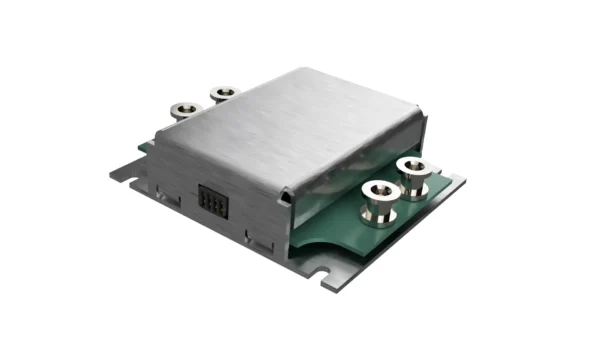
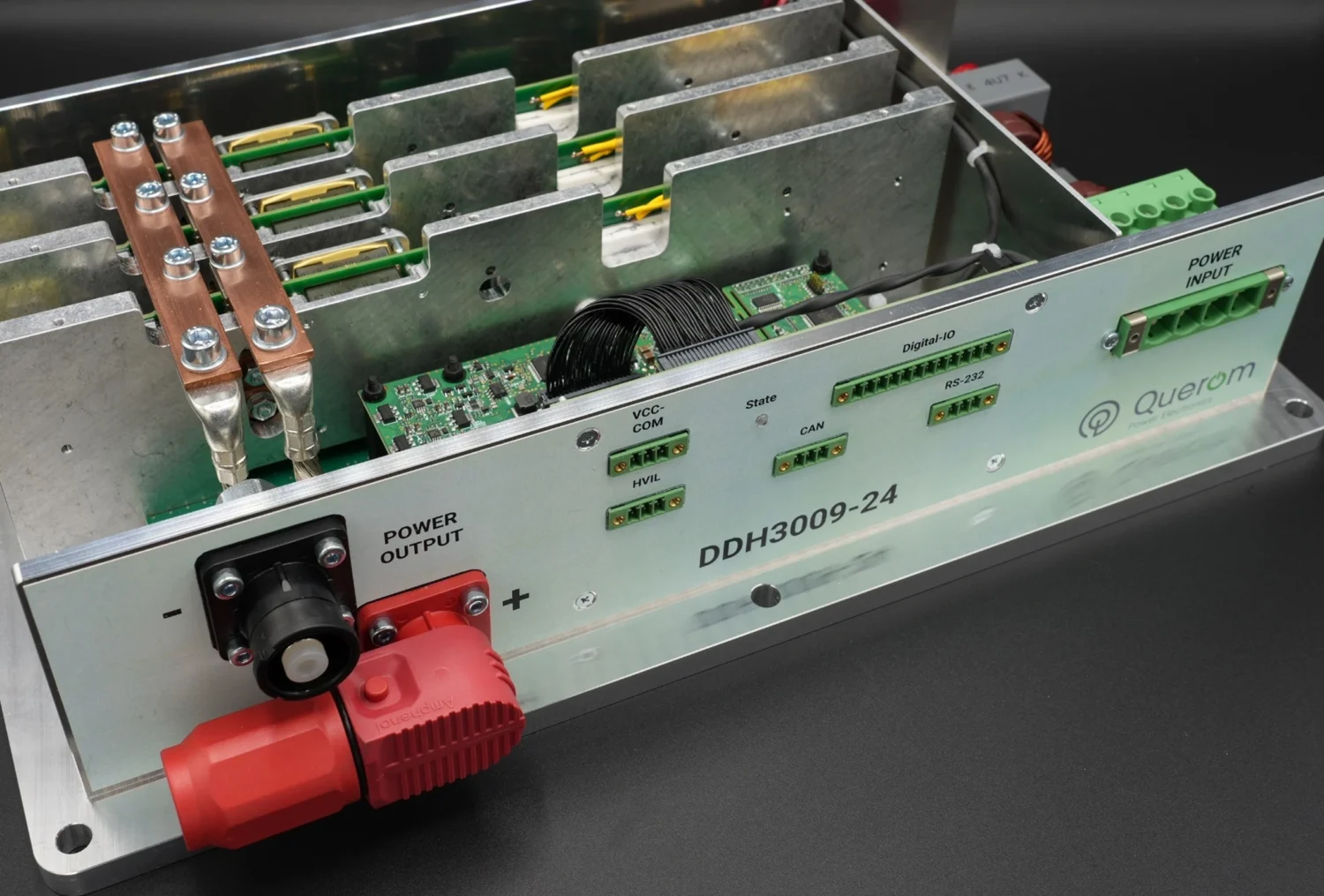
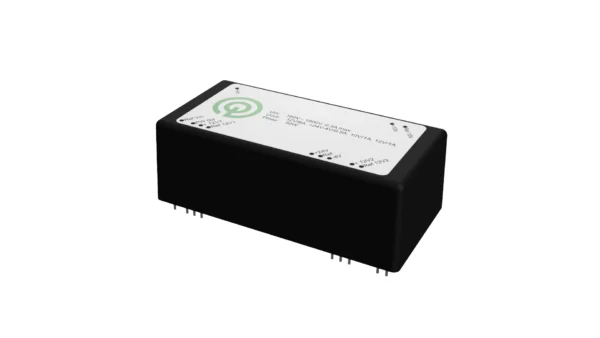
For applications with higher voltages, we offer the Querom HV platform: galvanically isolated converters with input voltages up to 1,000VDC and outputs for 12V, 24V and 48V onboard electrical systems. The DDH3009-24 converts 500–900VDC into regulated low voltages with up to 3 kW boost power and communicates via CAN, RS-232 and digital I/O. The DDH0015 (HV-AUX) complements the platform as a compact PCB auxiliary power supply module for control and sensor components directly from the HV DC link.
Application areas include industrial DC grids, stationary battery energy storage systems (BESS) and high-voltage onboard electrical systems for commercial and special-purpose vehicles. For voltage ranges or power classes beyond the standard, we develop customized HV derivatives based on the platform. This significantly reduces development time compared with a completely new design and enables hardware and software adaptations even for small pre-series quantities.
All specs, products and selection criteria: High-voltage DC/DC converters


Bidirectional, modular, isolated: the three core characteristics
Querom DC/DC converters differ from standard solutions through three core features: bidirectional energy flow, modular architecture, and controllability and diagnostic capability. The following sections explain each feature in detail – with specific application examples and product references.
Bidirectional DC/DC converters: Energy in both directions
Bidirectional DC/DC converters enable charging and discharging processes in a single device and are therefore indispensable for energy storage systems and recuperation applications. In mobile applications, bidirectional converters feed braking energy recovered during deceleration back into the storage system – an efficiency gain that significantly improves the range and uptime of industrial trucks in intralogistics. In BESS systems, bidirectional operation allows both grid charging and feeding power back into the grid without requiring a second converter.
Modular architecture: Scaling via parallel power stages
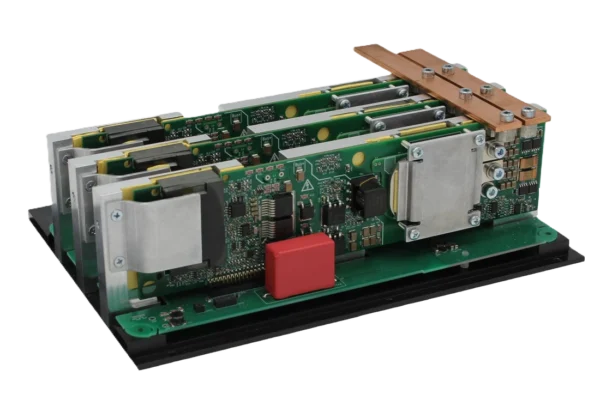
Querom’s modular platform concept enables power scaling via parallel power stages. Individual stages are switched on depending on load demand, allowing the converter to operate near its optimal efficiency point even under partial load. This principle is particularly valuable in systems with strongly fluctuating load profiles: instead of operating one large converter inefficiently at partial load, several smaller modules each operate at their optimal operating point. The concept also significantly shortens customized developments: Querom adapts existing modules to new voltages, power levels or interfaces instead of starting from scratch. For customers, this means shorter time to market and lower development costs.
Galvanic isolation: Isolation for high-voltage and LV drive applications
Galvanic isolation – also referred to simply as isolation – electrically separates the input and output circuits and transfers energy magnetically via a transformer. Galvanic isolation is always required whenever safety regulations demand a floating output side – for example in LV drives with touchable parts or when connecting HV DC links to low-voltage control systems. Important to know: the DDL series (DDL4848-48, DDL5096-96, DDL2148-24, DDL3050-48) is not galvanically isolated (non-isolated). We only offer galvanic isolation through the DDH platform (DDH3009-24) and within the scope of customized developments.
How do Querom DC/DC converters communicate with higher-level control systems?
Depending on the model, Querom DC/DC converters communicate with higher-level control systems via established industrial interfaces:
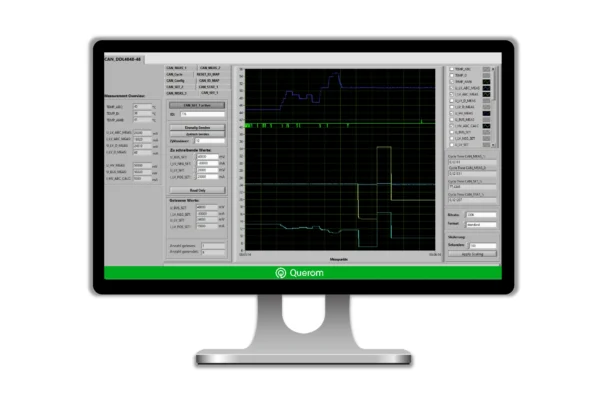
- CAN 2.0 (DDL4848-48, DDL5096-96, DDL2148-24): control of charging current, depth of discharge and operating mode via CAN messages. The converter transmits voltage, current, temperature and fault status to the higher-level control system in real time. Parameterization is also performed via CAN – all parameters are individually adjustable and stored in the device. The complete CAN mapping is available as separate documentation.
- RS-485 / Modbus RTU + analog + enable signal (DDL3050-48): for systems without CAN bus, the DDL3050-48 offers Modbus RTU connectivity via RS-485 – widely used in PLC environments and building automation. In addition, analog control inputs for current setpoint specifications and an enable signal for simple on/off switching are available. This considerably simplifies integration into existing machine control systems.
- CAN + digital I/O + RS-232 (DDH3009-24): the DDH3009-24 HV platform offers three parallel communication paths for different requirements. CAN handles system integration in complex DC grid architectures; RS-232 is used for diagnostics, firmware updates and initial parameterization in the lab. Digital I/O enables simple on/off switching and status queries without protocol overhead – ideal for safety-relevant emergency shutdown paths.
All interfaces, protocol details and CAN mappings are stored in the documentation for the respective products.

Which topologies of DC/DC converters are there?
Depending on the application, industrial DC/DC converters use one of eight established topologies. The choice of topology determines voltage direction, isolation behavior and efficiency. In the DDL series (48V and 96V), Querom uses non-isolated topologies (buck, boost, buck-boost); the DDH HV platform uses galvanically isolated topologies:
- Buck converter (step-down converter): lowers the input voltage to a lower output voltage and is the most common topology in industrial systems with a stable DC source. Within the Querom range, the DDL3050-48 uses this topology.
- Boost converter (step-up converter): raises the input voltage to a higher output level. Typical use: recuperation of braking energy and LV-to-HV coupling – in one direction of energy flow, the DDL2148-24 operates as a boost converter.
- Buck-boost converter: combines both directions and can both step the voltage down and step it up. Suitable for systems with a very wide input voltage range, for example with strongly fluctuating fuel-cell terminal voltages.
- Flyback converter: galvanically isolated topology for small to medium power levels. Energy is transferred magnetically via a transformer; the galvanic isolation enables safety-relevant applications.
- Forward converter: galvanically isolated topology for medium power levels up to several kilowatts. It transfers energy only during the transistor’s on-phase and offers higher efficiency than a flyback converter.
- Full-bridge converter: high-performance galvanically isolated topology for high output powers from approx. 1kW upward. Four switches in an H-bridge configuration enable precise control and high efficiency.
- DAB (Dual Active Bridge): bidirectional, galvanically isolated topology with very high efficiency in both energy flow directions. Preferred in HV-BESS applications and vehicle-to-grid systems.
- LLC converter: resonant galvanically isolated topology with very low switching losses. Ideal for high switching frequencies and wide input voltage ranges; achieves very high efficiency due to ZVS (Zero Voltage Switching) or ZCS (Zero Current Switching).
Would you like to dive deeper into the individual topologies? A detailed description can be found in our technical article DC/DC Converter Topologies – Switching Principles, Types, and Selection Criteria.
What distinguishes a buck converter from a boost converter?
Buck converters (step-down converters) and boost converters (step-up converters) are the two most common topologies in industrial systems. The fundamental difference lies in the relationship between input voltage and output voltage.
| Feature | Buck (Step-Down) | Boost (Step-Up) |
| Voltage direction | Output < Input | Output > Input |
| Typical application | Battery supply, auxiliary voltage, motor control | Recuperation, LV→HV coupling, voltage step-up for storage systems |
| Querom product example | DDL3050-48 (buck, 40–60VDC input, dual output 3kW + 24V) | DDL4848-48/ 2148-24 (boost direction: 24V→48V, bidirectional, 100A) |
In the Querom range, the DDL3050-48 operates as a buck converter (40–60VDC input to a regulated lower output voltage), whereas the DDL4848-48 and DDL2148-24 operate as buck converters in one direction of energy flow and as boost converters in the other.
Checklist – How to choose the right DC/DC converter for a project
Selecting a DC/DC converter for your industrial system follows five steps:
- Determine the voltage class: Define whether your system requires 48V, 96V or high voltage. The converter’s input voltage tolerance must fully cover the range of your source grid – including transient overvoltages during recuperation or load dump.
- Define power and current demand: Determine continuous current and short-term peak current under worst-case conditions. Plan for a safety margin of 20 to 30% on continuous current, since thermal overload considerably reduces converter service life. Also consider the starting current of drive systems.
- Clarify the direction of energy flow: Decide whether unidirectional operation is sufficient (e.g. pure supply from a fuel cell) or whether bidirectional operation is required (BESS, recuperation, coupling of two grids). A bidirectional converter can handle both tasks, but is generally more complex and more expensive than a unidirectional solution.
- Define interface and communication: Clarify which communication protocol your higher-level control system expects: CAN 2.0 (DDL4848-48, DDL5096-96, DDL2148-24), Modbus/RS-485 (DDL3050-48) or CAN + digital I/O + RS-232 (DDH3009-24). Choosing the wrong interface can lead to rework during commissioning.
- Clarify cooling and ambient conditions: Check the thermal installation situation in the housing or control cabinet: is sufficient free convection available, or is active cooling required? Querom converters are designed for operating temperatures from 0 to 80°C. In the case of limited convection or elevated ambient temperature, we recommend derating or active cooling – we will be happy to advise you.
Which specifications do you need to know?
For dimensioning, you should clarify eight specifications in advance:
- Input voltage range: defines which source grids are compatible – e.g. 40–60VDC for the 48V class. The range must cover all operating states, including undervoltage during deep discharge and overvoltage during recuperation.
- Output voltage and regulation tolerance: the desired nominal output voltage and the permissible deviation under load. In Querom converters, the output voltage can be adjusted via CAN or analog interface.
- Continuous power (rated current): the power delivered continuously during nominal operation – determines thermal design. Converters must be able to operate continuously at rated current without thermal shutdown.
- Peak power (transient current): short-term overload during startup of drives, capacitors or system starts. Querom converters provide defined overcurrent protection and inrush current limitation.
- Efficiency: industrial converters of the DDL series achieve 94 to 97% at nominal load; the highest efficiency occurs at 60 to 80% load. Modular stages keep efficiency high even under partial load.
- Cooling and ambient temperature: Querom converters are designed for operating temperatures from 0 to 80°C. Clarify whether convection cooling is sufficient or active cooling is necessary.
- Communication and control: CAN 2.0, Modbus/RS-485, RS-232, analog or digital I/O – depending on the system architecture. The choice of interface should be defined early in system design.
- Certifications: EN 62368-1 (safety), EMC standards EN 61000 and CE depending on the installation environment. For special requirements (marine approval, UL), please contact us in advance.
What efficiency is realistic for DC/DC converters?
Industrial DC/DC converters typically achieve efficiencies of 94 to 97% at nominal load. The highest efficiency is usually reached at 60 to 80% of full load; under partial load, efficiency decreases. SiC semiconductors and modular architecture help keep switching losses low even at lower loads. The table shows the documented efficiencies for each Querom product:
| Product | Buck efficiency | Boost-efficiency |
| DDL4848-48 | min. 96% (bei ILV > 0,5 × ILV,nom) | min. 94% |
| DDL5096-96 | min. 96%, typ. 97% | min. 96% |
| DDH3009-24 | — (unidirectional) | typ. 95% |
When is a bidirectional DC/DC converter useful?
A bidirectional DC/DC converter is useful whenever energy must flow in both directions – for example when charging and discharging an energy storage system or during recuperation of braking energy. In a BESS (battery energy storage system), the converter handles both the charging process (energy from the system into the storage unit) and the discharging process (energy from the storage unit into the system). In mobile robotics, bidirectionality enables braking energy to be fed back into the vehicle battery – a key lever for improving efficiency. Without bidirectionality, two separate converters would be required for charging and discharging, increasing installation space, cost and system complexity.
In which industrial systems are Querom DC/DC converters used?
Among others, Querom DC/DC converters are used in these five industrial sectors: mobile robotics and automated guided vehicles, energy storage systems (BESS), fuel-cell systems, marine and offshore applications, and high-voltage onboard electrical systems and DC grids. Each of these sectors has its own requirements in terms of voltage class, energy flow direction, communication and robustness. The following table provides initial guidance as to which Querom product is particularly suitable for which application area:
| Application Area | Recommended product | Voltage range | Energy flow |
| Mobile Robotics/ AGV/ AMR | DDL4848-48 | 48V | Bidirectional |
| Mobile Laser Applications | DDL5096-96 | 96V | Bidirectional |
| Fuel Cell Systems | DDL4848-48 / Custom HV | 48V – High-voltage | Unidirectional + backup power supply |
| DC Grid / High-Voltage Electrical System | DDH3009-24 | High-voltage | unidirectional / electrically isolated |
DC/DC Converters in Mobile Robotics and Autonomous Guided Vehicles (AGVs)
In driverless transport systems (DTS), automated guided vehicles (AGVs), and mobile robots (AMRs), a central DC/DC converter handles the drive power supply, energy recovery, and power supply to peripheral components (fans, control electronics, sensors) from a single power unit. The DDL4848-48 enables energy-efficient standby operation during idle and maintenance phases thanks to its sleep mode input.
DC/DC Converters in Mobile Laser Applications
In mobile laser applications, DC/DC converters supply power to the lasers from an energy storage device. They limit inrush currents during connection and regulate the output voltage to the desired level, regardless of the terminal voltage of the battery or supercapacitor. The laser’s supply voltage must meet high standards in terms of ripple, load steps, and regulation accuracy. For laser applications, we recommend the DDL5096-96.
DC/DC Converters in Fuel Cell Systems
In fuel cell systems, a DC/DC converter converts the highly fluctuating stack voltage (typically 48 to 500 V) into a regulated output voltage. Since the energy flow in fuel cell systems is typically unidirectional (only discharging from the cell), a unidirectional converter is sufficient in many cases. For peripheral functions such as temperature control and auxiliary power, a parallel 24 V/48 V auxiliary power supply provides the necessary flexibility.
DC/DC Converters in High-Voltage Automotive Electrical Systems and DC Grids
In DC grids and high-voltage vehicle electrical systems, DC/DC converters step voltages between different levels: from the 650V grid voltage to 400V for lighting, or to 24V/48V for low-voltage drives and control systems. HV drives typically operate at 690V and feed a significant amount of power back into the system during braking. DC grid infrastructures with shared intermediate circuits enable direct energy recovery without conversion—an efficiency and cost advantage over traditional AC infrastructure.
Your DC/DC converter – tailored to your system
We are enthusiasts for power electronics and develop industrial DC/DC converters that fit your system – not the other way around. Tell us about your project and we will find the right DC/DC converter or work together with you to develop a customized solution based on our modular platform concept. Find out more directly about a customized development.

FAQ – DC/DC converter
Can DC/DC converters be operated in parallel?
Yes, DC/DC converters can be operated in parallel. Querom converters support parallel operation; however, symmetrical load sharing does not occur automatically via current sharing, but requires all converters to communicate with a higher-level controller.
Are Querom DC/DC converters customizable?
Yes, Querom DC/DC converters can be customized both in hardware and software. Based on its modular platform concept, Querom implements customized voltages, power ratings, interfaces, and enclosure types—with significantly shorter development times than those required for a completely new design. For more information on custom development, see Custom DC/DC Converter Development.
Which certifications do Querom DC/DC converters meet?
Querom DC/DC converters are designed for industrial use in accordance with current industrial standards:
- CE marking: Conformity with EU directives
- EN 62368-1: Product safety (replaces EN 60950 and EN 60065)
- EN 61000-6-3 / EN 61000-6-4: EMC emissions (residential/industrial environments)
- EN 61000-4-2 (ESD): Immunity to electrostatic discharge
- EN 55032: EMC requirements for multimedia equipment (DDL3050-48)
What delivery times apply to Querom DC/DC converters?
Delivery times depend on the product and the scope of the project. Availability varies for standard products from the DDL series and for custom designs. For a specific quote and current delivery times, please contact us directly—you can reach us quickly via our contact form or by speaking with Anton Mitterreiter.
We look forward to hearing from you.

Anton Mitterreiter
Product Manager
a.mitterreiter@querom.de
+49 8743 967197-4